Why should we care?
SCS’s ability to provide a quality, equitable education is being undercut by high teacher turnover and year-long teaching vacancies, as well as significant maintenance deficiencies within the schools, all of which leads to higher financial, educational, and health costs. A lack of access to wraparound services provided by qualified social workers, psychologists, and nurses inhibits the successful treatment of trauma or Adverse Childhood Experiences (ACE). Abuse, neglect, and trauma significantly increase the likelihood of suspensions, juvenile criminal behavior, and incarceration. With a median age four years below the national average, Memphis’s population can support economic development, but only if we provide children in our community access to opportunities and support.
.png)
Equipping people of faith and goodwill to organize communities for systemic change through collective action.

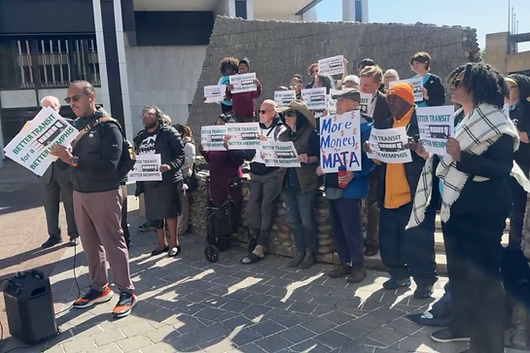
Better Transit for a Better Memphis, led by daily riders and other community champions, organizes and advocates for fully funded, accessible, and equitable public transit.
Mayor Young’s Transit Equity Day 2025 statement of support for transit
“Public transportation is more than just a means of travel—it is a vital resource that
connects people to opportunities, strengthens communities, and promotes environmental
sustainability...The City of Memphis remains committed to advancing these values
through our Transit Vision Plan, ensuring that our transit systems are inclusive,
reliable, and beneficial to all residents.”
-
Contents
- Mayor Young’s Transit Equity Day 2025 statement of support for transit
- BTBM strongly urges City Council to increase support for MATA to a $50 million Operating Budget
- Memphis can afford $50 million for MATA’s FY2026 Operating Budget
- Benefits of Adding $20 million to MATA Fiscal ’26 Budget
- Martin Luther King, Jr.’s statement of support for transit
- Background on Memphis Funding for MATA
BTBM strongly urges City Council to increase support for MATA Operating Budget - by adding $20 million to the Mayor’s proposed $30 million. This change would:
-
Implement 100% of MATA’s published BUT unfulfilled route schedule (the published schedule should be considered a “contract” with riders). Only 70% was realized this year – causing many bus “no shows”, which are an egregious failure to meet MATA’s contract with riders.
-
Restart the steel-wheeled Main St. Trolley – The Trolley had been MATA’s highest ridership route and is
important to stimulate commerce downtown for residents and businesses.
-
Provide $10 million to pay vendor outstanding balances and restore MATA’s credibility.
-
Reduce MATA’s $40 million Balance Sheet shortfall, which is mainly unpaid pension obligations, that were inaccurately reported earlier as “operational deficits” by the media.
-
Demonstrate the City’s commitment to daily riders, the community and to new executive position
candidates as MATA begins its national search for a new CEO, CFO and other key positions.
-
Recognize that the City’s contribution to MATA’s operating budget has not kept up with inflation, and the proposed $30m budget for FY26 will in fact be $16.6m below our estimate of $46.6m when inflation is added to the FY2020 budget of $32.7m. Clearly, Memphis has underfunded transit for many years! $45 million will adjust for inflation and $50 million will fund return of the Steel-wheel Trolleys. (See the US Transportation inflation adjustment calculator here!)


Martin Luther King, Jr.’s statement of support for transit, Jan. 1969
In “A Testament of Hope”, posthumously published essay:
“Urban transit systems in most American cities, have become a genuine civil rights
issue -- and a valid one -- because the layout of rapid-transit systems determines the
accessibility of jobs to the black community.”
Memphis Can Find $50 million for MATA’s FY2026 Operating Budget
-
Provide $10 million to pay vendor outstanding balances and restore MATA’s credibility.
-
Re-allocate budget priorities; adjust other departments’ budgets accordingly.
-
Audit PILOT funds which should have generated $6.6m for FY25 and $10.8m in FY26. (according to the City’s 2022 projected schedule).
-
Provide Shelby County a seat on the MATA Board in exchange for resuming their Operating and CIP budget contributions and designating their portion of PILOTs to MATA.
-
Research new sustainable sources of dedicated funding for MATA such as a transit utility fees, like the MLGW Stormwater fee (would require a referendum in 2026) and possible Federal and State increases.
Benefits of Adding $20 million to MATA’s Fiscal ’26 Budget
-
Up to 45% more jobs reachable in an hour by transit (Under full 2018 Transit Vision Plan)
-
Employees can reliably get to work on time.
-
More Equitable Access to school, medical appointments, shopping, entertainment, visiting friends and family and more equitable access for disabled.
-
Transit is infrastructure- like roads, water, sewer, electricity, police, fire and education.
-
17,000 more jobs reachable in an hour by transit a 39% increase according to Innovate Memphis 2024
-
Reducing poverty, Reducing crime.
-
Provides mobility to the over 25,000 households in Memphis that do not have access to a car
-
Transit is more affordable than car ownership- daily bus passes cost less than $800 for a full year, vs. average annual car ownership costs between $8000 and $12000 per year.
-
Access to Educational and Career Training Opportunities – too many colleges students dropout due to unreliable transit to classes.
-
Meeting the mobility needs of our citizens with disabilities (MATA doesn’t currently meet service
requirements specified in the Americans with Disability Act- allowing riders request trips one day in advance instead of three).
-
Environmental Justice- Less traffic. Cleaner air. Fewer emissions. Important climate solution.
Background on Memphis Funding for MATA
-
Peer Cities Comparisons- Memphis ranks dead last and has fallen embarrassingly far behind many Peer Cities in their contribution of transit Operating Budgets- total contribution, and contribution per capita. Memphis’ budget is less than half the budgets of four Peer Cities, and one-third of El Paso.

-
In FY20, prior to COVID, the City’s contribution to the MATA Operating Budget peaked at $32.7m.
FY21 & FY22 Federal COVID funds and other sources provided only $19.2m for each year. This
contributed to MATA’s current $40m balance sheet deficiency (as reported by the TN state Comptroller).
-
In FY22, the City Council designated all retiring PILOTs to a dedicated “Mobility Fund”, primarily for
transit – proposed by MICAH, the Sierra Club Chickasaw Group and the Memphis Chamber. Then
Memphis’s COO, Doug McGowan, estimated that PILOTs should produce $15.1m from FY23 through FY25, and $10.8m in FY26. The County Commission approved a similar proposal.
-
Mayor Young reduced MATA funding by $5m to $30m for FY26, ignoring the $5m increment which
had been added in FY25 to prevent layoffs and route cuts, as promoted by BTBM and 1000 signatures.
-
Memphis has provided matching CIP funds to high profile grants such as the Federally funded Bus
Rapid Transit (BRT). BRT is on hold until the City demonstrates it can sustain this innovation.
-
Local Capital Improvement Funds for MATA peaked at $24.9m in FY17 and fell to $4.4m in FY25.